
About East Zone the Region
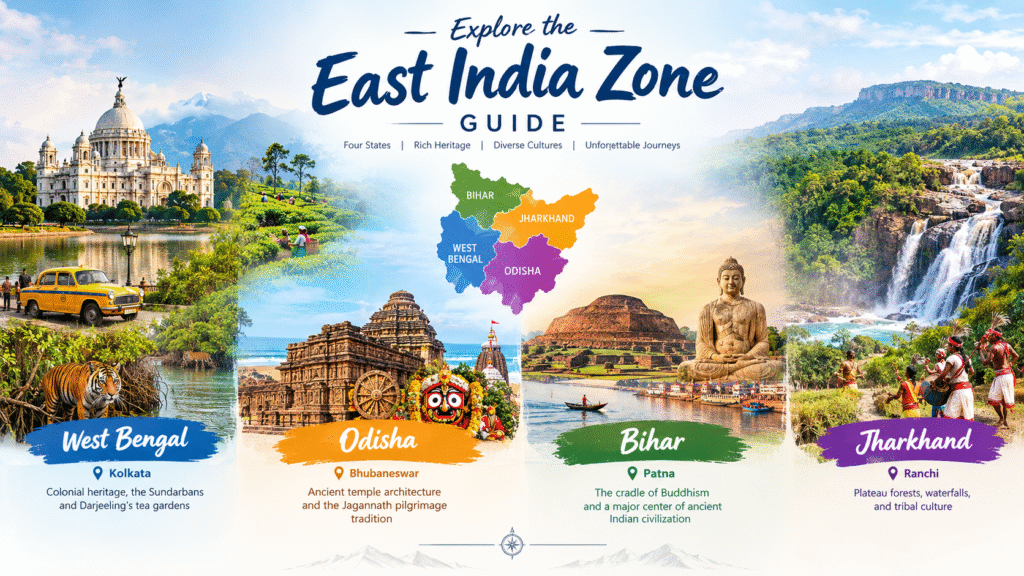
East India is one of the country’s most culturally rich and historically layered zones, stretching from the Himalayan foothills of Darjeeling in the north to the Bay of Bengal coastline in the south. The region encompasses four states — West Bengal, Odisha, Bihar, and Jharkhand — each carrying a distinct identity shaped by centuries of empire, religion, art, and trade.
This is the land where the Ganges completes its long journey to the sea, where Buddhism took root under the Bodhi Tree at Bodh Gaya, and where the Vijayanagara-era temple architecture of Odisha rivals anything found elsewhere in India. Kolkata, once the capital of British India, remains the region’s cultural and intellectual heart, while Odisha’s ancient temple towns and Bihar’s Buddhist pilgrimage circuit draw travelers seeking history rather than spectacle.
Unlike the more heavily touristed circuits of North and South India, East India rewards travelers with a quieter, more contemplative experience — colonial architecture fading gracefully alongside 800-year-old temples, tribal traditions in the Jharkhand highlands sitting a few hours from cosmopolitan Kolkata, and one of the world’s largest river deltas forming the Sundarbans mangrove forest along the coast. The zone’s geography is remarkably varied: dense mangrove wetlands, rolling plateau forests, fertile Gangetic plains, and a long stretch of sandy coastline, all within a few hours of each other.
For travelers planning an India itinerary, East India offers a distinctive counterpoint to the more familiar Rajasthan-Kerala-Goa circuit — a region where history, faith, and nature intersect with far fewer crowds.
States & Union Territories
East India, as covered in this guide, comprises four states:
- West Bengal — capital Kolkata; known for colonial heritage, the Sundarbans, and Darjeeling’s tea gardens
- Odisha — capital Bhubaneswar; known for ancient temple architecture and the Jagannath pilgrimage tradition
- Bihar — capital Patna; known as the cradle of Buddhism and a major center of ancient Indian civilization
- Jharkhand — capital Ranchi; known for its plateau forests, waterfalls, and tribal culture
There are no union territories within this zone, though the region borders Sikkim, Assam, and international boundaries with Bangladesh, Nepal, and Bhutan, adding further cultural cross-currents to its northern reaches.
Major Cities
- Kolkata (West Bengal) — the zone’s largest city and former capital of British India, a hub of art, literature, and colonial architecture
- Darjeeling (West Bengal) — a Himalayan hill station famous for tea and mountain views
- Bhubaneswar (Odisha) — the “Temple City,” home to hundreds of ancient shrines
- Puri (Odisha) — a major pilgrimage town on the Bay of Bengal coast
- Patna (Bihar) — the state capital, with a long history dating to the ancient Magadha empire
- Gaya / Bodh Gaya (Bihar) — Bihar’s most significant pilgrimage destination for Buddhists worldwide
- Ranchi (Jharkhand) — the state capital, gateway to Jharkhand’s waterfalls and plateau country
- Jamshedpur (Jharkhand) — India’s first planned industrial city, founded by the Tata Group
Top Tourist Destinations
The zone’s headline destinations span heritage, faith, and nature:
- Darjeeling — tea estates, Himalayan views, and the UNESCO-listed toy train
- Kolkata — Victoria Memorial, Howrah Bridge, and a living colonial-era streetscape
- Puri — the Jagannath Temple and its famous Rath Yatra festival
- Konark — the UNESCO-listed Sun Temple, shaped like a colossal stone chariot
- Bodh Gaya — the site of Buddha’s enlightenment, one of Buddhism’s holiest places
- Sundarbans — the world’s largest mangrove forest, home to the Bengal tiger
- Netarhat — a quiet Jharkhand hill station known for sunrise and sunset viewpoints
- Bhubaneswar — hundreds of centuries-old temples in a single city
Historical & Heritage Places
East India’s historical depth spans over two millennia, from ancient empires to colonial architecture:
- Victoria Memorial, Kolkata — a grand white-marble monument built in memory of Queen Victoria, now a museum of colonial-era India
- Howrah Bridge, Kolkata — an engineering landmark and one of the busiest cantilever bridges in the world
- Nalanda, Bihar — ruins of one of the world’s oldest residential universities, dating to the 5th century CE, a UNESCO World Heritage Site
- Rajgir, Bihar — an ancient city associated with both Buddhist and Jain history, with hot springs and hilltop stupas
- Udayagiri and Khandagiri Caves, Bhubaneswar — 2,000-year-old rock-cut Jain caves
- Konark Sun Temple, Odisha — a 13th-century UNESCO World Heritage Site built in the form of a colossal chariot
- Jamshedpur’s Tata heritage sites, Jharkhand — India’s earliest planned industrial city, notable for early 20th-century urban planning
Religious Destinations
Faith runs deep through East India’s geography, spanning Hinduism, Buddhism, and Jainism:
- Jagannath Temple, Puri — one of the four Char Dham sites in Hinduism, famous for its annual Rath Yatra chariot procession drawing millions of devotees
- Mahabodhi Temple, Bodh Gaya — a UNESCO World Heritage Site marking the spot where Siddhartha Gautama attained enlightenment under the Bodhi Tree
- Lingaraj Temple, Bhubaneswar — one of the oldest and largest Shiva temples in Odisha, an exceptional example of Kalinga architecture
- Dakshineswar Kali Temple, Kolkata — a major Hindu pilgrimage site on the banks of the Hooghly River
- Belur Math, Kolkata — headquarters of the Ramakrishna Mission, architecturally blending Hindu, Islamic, and Christian styles
- Vishnupad Temple, Gaya — dedicated to Lord Vishnu, an important site for ancestral rites (Pind Daan) in Hindu tradition
- Pawapuri, Bihar — a significant Jain pilgrimage site believed to be where Lord Mahavira attained nirvana
Hill Stations
The zone’s Himalayan foothills and Jharkhand plateau offer welcome respite from the plains’ heat:
- Darjeeling, West Bengal — the region’s most famous hill station, known for tea gardens and Kanchenjunga views
- Kalimpong, West Bengal — a quieter alternative to Darjeeling, known for monasteries and flower nurseries
- Netarhat, Jharkhand — dubbed the “Queen of Chotanagpur,” known for its forested plateau and sunrise/sunset points
- Ghatshila, Jharkhand — a lesser-known riverside retreat amid low hills and forests
- Mandarmani hills area (moderate elevation stretches near Purulia, West Bengal) — increasingly popular for offbeat weekend trips from Kolkata
Beaches
East India’s coastline runs along the Bay of Bengal through Odisha and West Bengal:
- Puri Beach, Odisha — a long, sandy beach known for sunrise views and traditional sand art
- Chandipur Beach, Odisha — unique for its dramatic tidal retreat, where the sea recedes several kilometers at low tide
- Gopalpur-on-Sea, Odisha — a quieter colonial-era beach town with a lighthouse
- Digha, West Bengal — one of Bengal’s most popular beach getaways, easily reached from Kolkata
- Mandarmani, West Bengal — known for its long drivable beach stretch, popular with weekend travelers
Wildlife & National Parks
The zone’s forests and wetlands support significant biodiversity:
- Sundarbans National Park, West Bengal — the world’s largest mangrove forest and a UNESCO World Heritage Site, home to the Bengal tiger and Gangetic dolphins
- Simlipal National Park, Odisha — a biosphere reserve known for tigers, elephants, and waterfalls within its forested terrain
- Betla National Park, Jharkhand — one of India’s earlier tiger reserves, also home to elephants and diverse birdlife
- Bhitarkanika National Park, Odisha — a mangrove ecosystem known for saltwater crocodiles and Olive Ridley turtle nesting
- Valmiki Tiger Reserve, Bihar — a forested reserve along the Nepal border, part of the Terai wildlife corridor
Nature & Waterfalls
Jharkhand and Odisha in particular offer dramatic natural landscapes:
- Chitrakote Falls area (bordering Chhattisgarh, accessible via Odisha routes) — often described as India’s widest waterfall
- Hundru Falls, Jharkhand — a dramatic 98-meter waterfall near Ranchi, most spectacular just after monsoon
- Dassam Falls, Jharkhand — a scenic multi-tiered waterfall close to Ranchi
- Jonha Falls, Jharkhand — also known as Gautamdhara, associated with Buddhist legend
- Chilika Lake, Odisha — Asia’s largest brackish water lagoon, a haven for migratory birds and Irrawaddy dolphins
- Duduma Falls, Odisha — a striking waterfall along the Odisha-Andhra Pradesh border
Adventure Destinations
While not primarily known for adventure tourism, East India offers pockets of activity for those seeking it:
- Sundarbans boat safaris, West Bengal — navigating narrow mangrove creeks in search of tigers and crocodiles
- Trekking around Darjeeling and Kalimpong — routes through tea estates and forested ridgelines with Himalayan views
- River rafting near Ranchi, Jharkhand — seasonal rafting opportunities on rivers around the Jharkhand plateau
- Rock climbing and rappelling at Susunia Hill, West Bengal — a popular spot for beginner-level climbing near Bankura
- Birdwatching at Chilika Lake, Odisha — one of India’s premier destinations for spotting migratory bird species, especially November to February
Things to Do
- Ride the UNESCO-listed Darjeeling Himalayan Railway (toy train) through tea estate scenery
- Take a sunrise boat ride on the Hooghly River in Kolkata past Howrah Bridge
- Attend the evening Ganga Aarti or explore Dakshineswar and Belur Math together
- Witness the Rath Yatra festival in Puri, one of India’s largest religious processions
- Explore the intricately carved Konark Sun Temple and its surrounding archaeological museum
- Take a mangrove boat safari through the Sundarbans in search of the elusive Bengal tiger
- Meditate under the Bodhi Tree at Bodh Gaya’s Mahabodhi Temple complex
- Walk through the ancient ruins of Nalanda University
- Sample Kolkata’s legendary street food scene, from puchka to kathi rolls
- Photograph the tribal art and mask-making traditions of rural Odisha and Jharkhand villages
Food & Local Cuisine
East India’s cuisine is defined by its relationship with rice, fish, and subtly sweet flavor profiles:
- Bengali cuisine — centers on fish (especially hilsa and rohu), mustard-based gravies (shorshe), and an extraordinary tradition of milk-based sweets including rasgulla, sandesh, and mishti doi
- Odia cuisine — known for its temple food tradition (mahaprasad at Puri’s Jagannath Temple), dalma (a lentil-vegetable stew), and pakhala bhata (fermented rice, especially popular in summer)
- Bihari cuisine — famous for litti chokha (roasted wheat balls served with mashed spiced vegetables), sattu-based dishes, and thekua (a traditional sweet)
- Jharkhandi/tribal cuisine — features rustic preparations like dhuska (rice-lentil fritters), pittha (steamed rice dumplings), and handia, a traditional fermented rice beverage
- Street food — Kolkata’s puchka (the Bengali version of pani puri), kathi rolls, and jhalmuri are essential tasting experiences
Culture & Traditions
East India’s cultural identity is deeply tied to its artistic and intellectual heritage:
- West Bengal has produced some of India’s most significant literary and artistic figures, including Rabindranath Tagore, and remains a center for Bengali theater, cinema, and classical and folk music traditions like Baul music
- Odisha’s classical dance form, Odissi, is one of India’s eight recognized classical dance styles, with roots tracing back over 2,000 years to temple ritual performance
- Bihar’s cultural legacy stretches back to the Maurya and Gupta empires, and the region retains strong traditions of folk music, Madhubani painting (originating in the Mithila region), and oral storytelling
- Jharkhand’s tribal communities — including the Santhal, Oraon, and Munda peoples — maintain distinct traditions of dance (such as the Santhal dance), music, and craft, particularly evident during harvest festivals
- Traditional handicrafts across the zone include Odisha’s Pattachitra scroll painting, West Bengal’s terracotta temple art (notably at Bishnupur), and Bihar’s Madhubani paintings, all recognized internationally for their artistic distinctiveness
Festivals & Events
- Durga Puja (West Bengal) — the region’s largest festival, transforming Kolkata into an open-air art exhibition of elaborately themed pandals, typically in September/October
- Rath Yatra (Puri, Odisha) — the annual chariot procession of Lord Jagannath, one of India’s most significant religious festivals, drawing millions of pilgrims
- Chhath Puja (Bihar) — a major festival honoring the Sun God, observed with rituals along riverbanks and ponds, especially significant in Bihar and eastern UP
- Sarhul (Jharkhand) — a tribal spring festival celebrating nature and the sal tree, marked by traditional dance and music
- Khajuraho-style dance festivals are absent here, but Konark Dance Festival (Odisha) — an annual classical dance festival held against the illuminated backdrop of the Sun Temple, typically in early December
- Poila Boishakh (Bengali New Year) — celebrated across West Bengal in mid-April with cultural programs and traditional food
Best Time to Visit
October to March is the ideal window across most of East India, offering comfortable temperatures (15–28°C) suited to sightseeing, temple visits, and wildlife safaris. This period also coincides with major festivals like Durga Puja (September/October) and the Konark Dance Festival (December).
Summers (April to June) are hot and humid across the plains, particularly in Bihar and inland Odisha, though hill stations like Darjeeling remain comfortable and are a popular summer escape.
Monsoon (July to September) brings heavy rainfall throughout the zone, especially in West Bengal and coastal Odisha, making it less ideal for travel, though it’s the best season for waterfalls in Jharkhand and lush scenery in Darjeeling’s tea gardens.
For the Sundarbans, the November to February window offers the best wildlife visibility with cooler, drier weather and calmer waterways.
Transportation
By Air: Kolkata’s Netaji Subhas Chandra Bose International Airport is the zone’s primary aviation hub, with additional airports at Bhubaneswar, Patna, Ranchi, Gaya (seasonal international pilgrim flights), and Bagdogra (serving Darjeeling).
By Rail: East India is exceptionally well connected by rail, with Kolkata serving as a major national junction. Key stations include Howrah, Sealdah, Bhubaneswar, Patna Junction, and Ranchi, with direct long-distance trains to Delhi, Mumbai, and Chennai.
By Road: National highways connect the major cities, though road conditions can vary significantly in more rural stretches of Jharkhand and interior Odisha. Shared taxis and state transport buses are common for shorter regional hops.
Within Darjeeling and hill areas: The narrow-gauge Darjeeling Himalayan Railway (toy train) is a scenic, UNESCO-listed option, while shared jeeps handle most hill-station transport.
Travel Tips
- Book Durga Puja season accommodation in Kolkata well in advance, as the city sees enormous domestic tourist influx during this period.
- Carry cash for rural and temple-town areas, where card acceptance can be limited.
- When visiting the Jagannath Temple in Puri, note that non-Hindus are not permitted inside the main sanctum, though the temple can be viewed from the nearby Raghunandan Library building.
- Dress modestly at religious sites across the zone, particularly in Bodh Gaya and Puri.
- For Sundarbans visits, book through registered tour operators only, as navigating the reserve independently is neither permitted nor advisable.
- If trekking or visiting waterfalls in Jharkhand during monsoon, exercise caution around slippery rocks and rapidly rising water levels.
- Mosquito repellent is advisable across the zone, especially in coastal and mangrove areas.
Nearby Destinations
- Sikkim — bordering West Bengal’s north, easily combined with a Darjeeling trip for Gangtok and high-altitude lakes
- Chhattisgarh — accessible from southern Odisha, home to Chitrakote Falls and Bastar’s tribal heritage
- Assam — reachable from North Bengal, offering Kaziranga National Park and Northeast India’s broader circuit
- Jharkhand-Odisha border region — Simlipal National Park and Similipal Biosphere Reserve straddle accessible routes from both states
Weekend Getaways
- Digha, West Bengal — a classic short beach trip from Kolkata, roughly 3 hours by road
- Mandarmani, West Bengal — a popular drivable beach escape, slightly quieter than Digha
- Shantiniketan, West Bengal — Rabindranath Tagore’s university town, known for its rural, artistic atmosphere, about 3 hours from Kolkata
- Netarhat, Jharkhand — an easy weekend hill retreat from Ranchi
- Chandipur, Odisha — a short trip from Bhubaneswar known for its unique tidal beach
- Rajgir and Nalanda, Bihar — a compact one- to two-day historical circuit near Patna/Gaya
Famous Tourist Routes
- Kolkata – Darjeeling – Kalimpong circuit — combining colonial heritage with Himalayan hill stations, typically 5–6 days
- Bhubaneswar – Puri – Konark “Golden Triangle” of Odisha — the zone’s most popular short circuit, covering temples, pilgrimage, and coastal heritage in 3–4 days
- Patna – Rajgir – Nalanda – Bodh Gaya Buddhist circuit — following the historical and spiritual footsteps of early Buddhism, typically 4–5 days
- Kolkata – Sundarbans — a 2–3 day extension for wildlife and mangrove exploration
- Ranchi – Netarhat – Waterfalls circuit — a nature-focused route through Jharkhand’s plateau country, typically 3–4 days
Travel FAQ
Q: What is the best time to visit East India overall? October to March offers the most comfortable weather across all four states and aligns with the region’s major festivals.
Q: Is the Sundarbans safe to visit? Yes, when visited through registered tour operators with proper permits — independent exploration of the reserve is not permitted and can be genuinely hazardous given the presence of tigers and tidal creeks.
Q: How many days do I need to cover Odisha’s Golden Triangle? 3 to 4 days is generally sufficient for Bhubaneswar, Puri, and Konark at a comfortable pace.
Q: Can non-Hindus visit the Jagannath Temple in Puri? No, entry into the main sanctum is restricted to Hindus, though the temple can be viewed from a nearby building.
Q: Is Darjeeling accessible year-round? Yes, though the best mountain visibility is typically March to May and October to December; monsoon months bring heavy rain and cloud cover.
Q: What’s the easiest way to combine Kolkata with the Sundarbans? Most Sundarbans tours depart from Kolkata as 2–3 day packages including transport, permits, and boat safaris.
Q: Is Bodh Gaya only for Buddhist pilgrims? No — while it holds deep significance for Buddhists worldwide, the Mahabodhi Temple complex and surrounding international monasteries are open to all visitors regardless of faith.
Q: What language is most useful across the zone? Bengali (West Bengal), Odia (Odisha), Hindi/Bhojpuri (Bihar), and Hindi alongside tribal languages (Jharkhand) are the primary regional languages; Hindi and English are widely understood in tourist areas.